Girders & Bridges
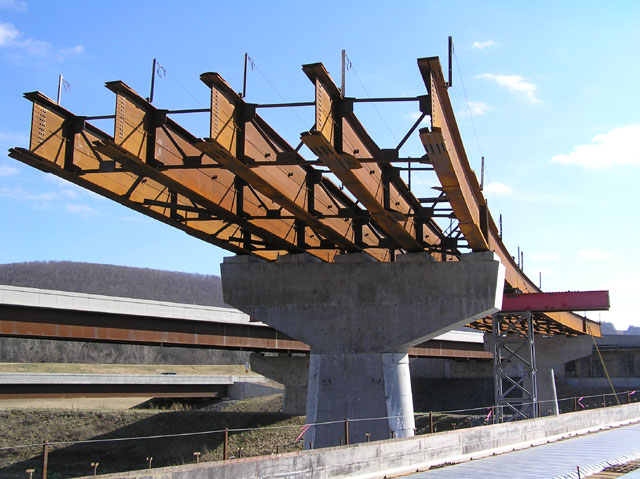
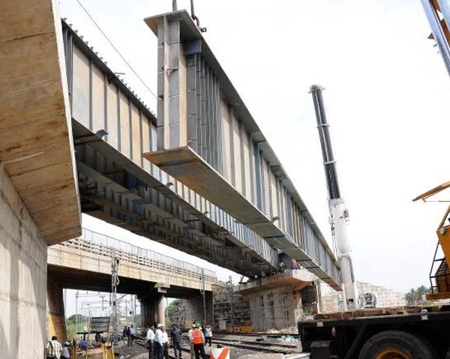
Girder bridges are the simplest bridge type in structure and consist of steel beams shaped to an I-section or box section, called a plate girder bridge or a box girder bridge, respectively. Girder bridges are comprised of deck slabs, on which vehicles and people pass, and of main girders supporting the deck slabs. Deck slabs include RC deck slabs, steel deck slabs, composite deck slabs, and PC deck slabs. Bridges where the deck slabs and the main girders work together to resist loads are called composite girder bridges, and bridges designed to resist loads with the main girders only are called non-composite girder bridges. VM Steeltech has experience in the manufacture and construction of both the types of bridges.
All bridges consist of two main parts: the substructure, and the superstructure. The superstructure is everything from the bearing pads, up – it is what supports the loads and is the most visible part of the bridge. The substructure is the foundation, transfers loads from the superstructure to the ground. Both must work together to create a strong, long-lasting bridge.
The superstructure consists of several parts:
- The deck is the roadway or walkway surface. In roadway applications it is usually a poured reinforced concrete slab, but can also be steel grid or wood plank. The deck includes any road lanes, medians, sidewalks, parapets or railings, and miscellaneous items like drainage and lighting.
- The supporting structure consists of the steel or concrete system supporting the deck. This includes the girders themselves, diaphragms or cross-braces, and (if applicable) the truss or arch system. In a girder bridge this would include only the girders and the bracing system. The girders are the primary load support, while the bracing system both allows the girders to act together as a unit, and prevents the beams from toppling.
- The job of the bearing pads is to allow the superstructure to move somewhat independently of the substructure. All materials naturally expand and contract with temperature – if a bridge were completely rigid, this would cause unnecessary stress on the structure and could lead to failure or damage. By fixing the superstructure at one end, while allowing the other end of a span to move freely in the longitudinal direction, thermal stresses are alleviated and the lifespan of the bridge increased.